UAE Free Zone Corporate Tax 2026: Complete Guide to 0% Eligibility, Tax Rates & Compliance
UAE free zone corporate tax 2026 is an important topic for entrepreneurs, investors, and business owners planning to establish or operate a company in the United Arab Emirates. While UAE free zones offer attractive business opportunities, a free zone licence does not automatically guarantee a 0% corporate tax rate.
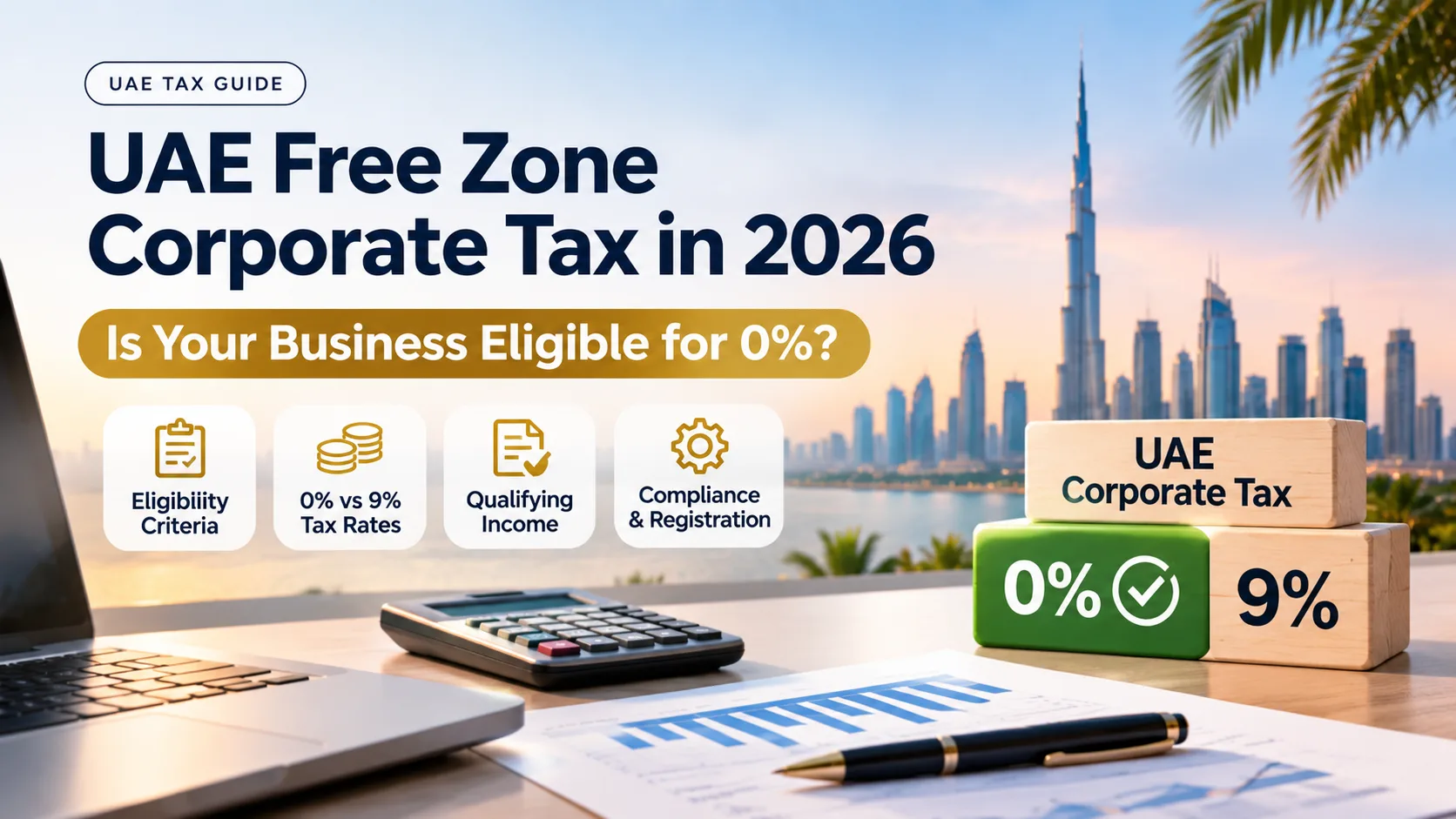
Under the UAE corporate tax framework, eligible Qualifying Free Zone Persons may benefit from a 0% corporate tax rate on Qualifying Income. Other taxable income may be subject to a 9% rate, depending on the company’s circumstances and applicable rules.
Understanding UAE free zone corporate tax 2026 requirements can help businesses plan their operations, meet regulatory obligations, and make informed financial decisions.
In this comprehensive guide, Main Zone Business Solutions explains corporate tax rates, eligibility conditions, qualifying income, registration requirements, and common compliance mistakes.
UAE Free Zone Corporate Tax 2026: Key Rules and Eligibility
The UAE introduced federal corporate tax for financial years beginning on or after June 1, 2023.
The corporate tax framework applies to businesses across the UAE, including companies established in free zones.
However, eligible free zone businesses may qualify for preferential tax treatment if they satisfy the requirements established under UAE corporate tax legislation.
Understanding the Corporate Tax Rates
The standard UAE corporate tax rates generally include:
- 0% on taxable income up to AED 375,000.
- 9% on taxable income exceeding AED 375,000.
For a Qualifying Free Zone Person, a separate preferential regime may apply:
- 0% on Qualifying Income.
- 9% on taxable income that is not Qualifying Income.
The standard AED 375,000 threshold and the preferential free zone regime are different rules and should not be confused.
For official tax guidance, visit the UAE Federal Tax Authority.
What Is a Qualifying Free Zone Person?
A Qualifying Free Zone Person (QFZP) is a free zone entity that satisfies specific requirements under UAE corporate tax legislation.
Meeting these conditions is essential for accessing the preferential corporate tax treatment.
1. Maintaining Adequate Substance
A qualifying business must maintain adequate substance in the UAE free zone, taking into account its activities and applicable legal requirements.
2. Earning Qualifying Income
The company must earn income that qualifies under the relevant corporate tax rules.
Not every business activity or transaction automatically generates Qualifying Income.
3. Meeting Transfer Pricing Requirements
Businesses must comply with applicable transfer pricing rules, including the arm’s-length principle and relevant documentation obligations.
4. Preparing Audited Financial Statements
Qualifying Free Zone Persons must comply with the applicable audited financial statement requirements.
5. Satisfying Additional Conditions
Other requirements may apply, including restrictions on non-qualifying revenue, excluded activities, and certain tax elections.
Failure to meet the applicable conditions may affect eligibility for the preferential tax regime.
What Is Qualifying Income Under UAE Corporate Tax?
Qualifying Income is income that satisfies the criteria established for the preferential free zone corporate tax regime.
Whether income qualifies depends on several factors, including:
- The nature of the business activity.
- The type of customer or counterparty.
- Whether the transaction involves a Qualifying Activity.
- Whether an Excluded Activity applies.
- The relevant regulatory conditions and exceptions.
Certain activities involving manufacturing, processing, distribution, logistics, and other specified business operations may qualify when the applicable requirements are satisfied.
However, ordinary consultancy, e-commerce, and professional services should not automatically be assumed to qualify for the 0% rate.
Businesses should review each relevant income stream carefully.
UAE Free Zone Corporate Tax 2026: 0% vs 9% Explained
One of the most important aspects of UAE free zone corporate tax 2026 is understanding the difference between preferential and standard tax treatment.
| Business Situation | Potential Tax Treatment |
|---|---|
| Qualifying Income earned by an eligible Qualifying Free Zone Person | 0% |
| Other taxable income under the QFZP regime | Generally 9% |
| Business not eligible for QFZP treatment | Standard corporate tax rules apply |
| Business with exempt income | Treatment depends on applicable exemptions |
For example, a free zone business may generate revenue from different types of activities.
Some transactions may meet the requirements for Qualifying Income, while others may fall outside the preferential regime.
The final corporate tax treatment depends on the company’s eligibility, transaction classifications, and applicable legislation.
Corporate Tax Registration Requirements in the UAE
Free zone companies generally need to assess and fulfill their corporate tax registration obligations.
Corporate tax registration is separate from company incorporation or trade licence issuance.
Businesses should understand:
- Their applicable corporate tax registration deadline.
- Their financial year and tax period.
- Their accounting and recordkeeping requirements.
- Their tax return filing obligations.
- Any additional reporting or compliance requirements.
Corporate tax returns are generally required within nine months after the end of the relevant tax period, subject to applicable exceptions.
Failure to meet registration or filing requirements may result in administrative penalties.
Businesses should consult the UAE Ministry of Finance and the Federal Tax Authority for official regulatory information.
Is Every UAE Free Zone Company Eligible for 0% Corporate Tax?
No. Establishing a business in a UAE free zone does not automatically make it eligible for preferential corporate tax treatment.
Eligibility depends on the company’s activities, income, operational substance, compliance, and other applicable conditions.
A business may need to apply the standard corporate tax regime if it does not qualify for the preferential free zone treatment.
Therefore, entrepreneurs should consider tax implications before selecting a business structure.
Corporate Tax and VAT: Understanding the Difference
Corporate tax and Value Added Tax (VAT) are separate components of the UAE taxation framework.
Corporate Tax
Corporate tax generally applies to taxable business profits or income.
The applicable rate depends on the relevant tax regime, taxable income, and eligibility conditions.
Value Added Tax (VAT)
VAT generally applies to taxable supplies of goods and services.
The standard UAE VAT rate is 5%, although zero-rating and exemptions may apply to qualifying transactions.
A company may have obligations under both tax systems.
Free zone status does not automatically eliminate VAT requirements.
Common UAE Corporate Tax Mistakes to Avoid
Assuming All Free Zone Income Is Tax-Free
Not every free zone company or income stream qualifies for preferential treatment.
Missing Registration Deadlines
Businesses should identify their corporate tax registration deadlines and complete the necessary procedures.
Maintaining Incomplete Financial Records
Accurate financial records are essential for calculating taxable income and demonstrating compliance.
Incorrectly Classifying Business Activities
The nature of a company’s activities and transactions may affect tax treatment.
Ignoring Changes in Tax Regulations
Businesses should monitor official regulatory updates and review their compliance procedures when relevant rules change.
Failing to Obtain Professional Advice
Companies with multiple activities, cross-border transactions, or complex ownership arrangements may benefit from qualified tax advice.
How to Prepare Your Free Zone Business for Corporate Tax in 2026
Businesses should take a structured approach to tax compliance.
Step 1: Review Your Business Activities
Identify the products, services, and transactions that generate revenue.
Step 2: Evaluate Tax Eligibility
Assess whether the company meets the conditions for Qualifying Free Zone Person status.
Step 3: Maintain Proper Accounting Records
Implement suitable bookkeeping and financial reporting procedures.
Step 4: Complete Required Tax Registration
Register for corporate tax within the applicable deadlines.
Step 5: Monitor Regulatory Changes
Review relevant updates from UAE tax authorities.
Step 6: Seek Professional Guidance
Consult a qualified tax adviser when eligibility or compliance requirements are uncertain.
Why Corporate Tax Planning Matters Before Company Formation
Corporate tax planning should be considered during the initial business setup process.
Choosing the appropriate jurisdiction, licence, business activities, and operational structure can influence future compliance requirements.
For entrepreneurs considering a UAE free zone company, understanding UAE free zone corporate tax 2026 rules can help avoid incorrect assumptions about tax benefits.
Main Zone Business Solutions assists entrepreneurs with business setup planning, company formation, licensing, and related corporate support services.
Explore our UAE Business Setup Cost Calculator to compare available company formation options.
Frequently Asked Questions About UAE Free Zone Corporate Tax 2026
1. Is corporate tax 0% for all UAE free zone companies?
No. The preferential 0% rate applies to Qualifying Income earned by eligible Qualifying Free Zone Persons, subject to the relevant legal conditions.
2. What is the corporate tax rate for UAE free zone companies in 2026?
Eligible Qualifying Free Zone Persons may benefit from a 0% rate on Qualifying Income, while other taxable income may be subject to a 9% rate. Companies outside the preferential regime generally follow the standard rules.
3. Do UAE free zone companies need corporate tax registration?
Free zone companies generally need to assess and fulfill their corporate tax registration obligations, even where preferential tax treatment may apply.
4. Is a free zone trade licence enough to qualify for 0% corporate tax?
No. Companies must meet the relevant eligibility, income, substance, and compliance requirements.
5. Does UAE corporate tax apply to small businesses?
Corporate tax obligations depend on the business’s legal status, taxable income, and applicable rules. Certain businesses may qualify for specific reliefs where the relevant conditions are met.
6. Can a UAE free zone company trade with mainland customers?
Depending on its licence and business model, a free zone company may conduct permitted transactions with mainland customers. Licensing permissions and corporate tax treatment must be evaluated separately.
7. Is VAT included in UAE corporate tax?
No. VAT and corporate tax are separate taxes with different registration, calculation, and filing requirements.
Start Your UAE Business with Main Zone Business Solutions
Understanding UAE free zone corporate tax 2026 requirements is an important part of planning a successful business.
At Main Zone Business Solutions, we help entrepreneurs and international investors explore UAE company formation options, including mainland, free zone, and offshore business setup.
Our services include:
- UAE company formation assistance.
- Business activity and licence selection.
- Trade licence application support.
- Visa and immigration processing assistance.
- Corporate bank account application support.
- Business consultancy and related corporate services.
Whether you’re launching your first business or expanding your operations in the UAE, our team can help you understand the available company formation options.
Ready to establish your company in the UAE?
Contact Main Zone Business Solutions today for professional business setup assistance.
Website: https://mainzone.ae/
Email: info@mainzone.ae
Phone: +971 50 202 7839
Explore Business Setup Packages: https://mainzone.ae/price/
Disclaimer: This article provides general information and does not constitute tax, accounting, or legal advice. Tax eligibility, rates, and compliance requirements should be verified against current UAE legislation and official guidance.