Setting up a business in the United Arab Emirates is one of the most strategic moves an entrepreneur or investor can make. With world-class infrastructure, strategic geographic positioning, and a business-friendly tax regime, the UAE attracts thousands of global founders every year. However, before you can incorporate your entity, file for residency visas, or open a corporate bank account, you must make the single most crucial structural decision of your entrepreneurial journey: choosing between a mainland vs free zone jurisdiction.
Making the wrong choice can restrict where you sell your products, inflate your overhead costs with unnecessary commercial lease requirements, or complicate your corporate tax and compliance obligations. On the other hand, selecting the right jurisdiction unlocks seamless market access, optimized tax structures, and maximum operational freedom.
As premier UAE business setup consultants headquartered in Julphar Tower, Ras Al Khaimah, with a dedicated liaison office in Dubai, the advisory team at Main Zone has helped over 500 founders navigate this exact choice. In this comprehensive, in-depth guide, we break down every core difference—from 100% foreign ownership laws and office leasing mandates to Dubai’s latest regulatory updates—so you can choose the optimal structure for your specific business model.
1. Understanding the Core Jurisdictions
Before diving into granular comparisons, it is essential to understand what mainland and free zone entities actually represent in the UAE business ecosystem.
What is a Free Zone Company?
A free zone is a designated, geographically bounded economic area within the UAE designed to promote international trade, foreign investment, and specialized industry sectors. Governed by its own independent Free Zone Authority (FZA) rather than federal onshore municipal laws, free zones (such as RAKEZ, IFZA, DMCC, and Meydan) provide an environment where international founders enjoy extraordinary commercial privileges.
Historically, free zone entities were designed primarily for international trade, holding structures, consulting, and cross-border commerce. Today, they house hundreds of thousands of startups, ecommerce brands, and digital service providers.
What is a Mainland Company?
A mainland company (often referred to as an onshore company) is registered directly with the Department of Economy and Tourism (DET)—formerly known as DED—in the respective emirate, such as Dubai or Ras Al Khaimah. Mainland companies operate under the direct oversight of UAE federal and local municipal laws.
Historically, mainland entities required a local Emirati shareholder holding at least 51% of the company shares. However, landmark federal commercial company reforms transformed the landscape, granting 100% foreign ownership for over 1,000 commercial and professional activities across the UAE mainland without needing a local partner.
2. Side-by-Side Comparison: Mainland vs Free Zone
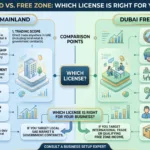
To evaluate which corporate vehicle fits your operational goals, review the direct structural comparison below:
| Comparative Feature | Mainland Company (DET Onshore) | Free Zone Company |
| Foreign Ownership | 100% for eligible commercial/professional activities | 100% foreign ownership guaranteed |
| Local UAE Market Access | Direct trading across all 7 emirates without restrictions | Restricted to free zone boundaries or international markets (unless licensed via branch/permit) |
| Government Tenders | Full eligibility to bid on federal and local municipal tenders | Generally restricted from bidding on public sector contracts |
| Physical Office Mandate | Mandatory physical office space with an Ejari tenancy contract | Flexible options: flexi-desks, virtual offices, or physical warehouses |
| Visa Quotas | Tied directly to the physical square footage of your commercial office | Tied to the specific package tier or office size chosen |
| Customs Duty & Tax | Standard UAE customs rules apply | 0% customs duty inside the zone; 0% corporate tax on qualifying free zone income |
3. Key Decision Factors: Which Structure Wins?
When founders evaluate a free zone or mainland company, the final decision typically hinges on four operational pillars: where your customers are located, your physical office budget, your need for government contracts, and your long-term tax strategy.
Factor A: Target Audience & Geographic Trading Rights
If your business model involves selling services or physical goods directly to retail consumers or corporate clients located anywhere within the UAE onshore market (e.g., opening a restaurant, a retail storefront, or providing on-site contracting services), a Dubai mainland company setup is mandatory.
Conversely, if your clientele is international, digital, or cross-border, a free zone company setup provides an agile, low-cost legal framework. Free zone entities can easily invoice international clients, manage global digital marketing agencies, or run remote ecommerce operations without maintaining a physical storefront.
Note on Dubai Free Zone Flexibility: Since the introduction of Dubai Executive Council Resolution No. 11, eligible Dubai free zone companies can secure a branch license or temporary permit from the DET to operate directly on the Dubai mainland under specific conditions. Your advisor can calculate whether this hybrid route is cheaper than establishing a full mainland LLC.
Factor B: Office Space and Overhead Expenses
Overhead is one of the most critical considerations for early-stage founders.
-
Free Zones excel at cost-efficiency. Many authorities offer “flexi-desk” arrangements—shared workstation spaces that satisfy regulatory registration requirements without forcing you to pay thousands of dirhams in monthly commercial rent.
-
Mainland Entities strictly require a physical commercial office or retail shop verified by a registered Ejari tenancy contract. While this increases initial setup costs, it grants you unlimited visa allocation scaling based on square footage.
Factor C: Corporate Tax and Financial Compliance
Both jurisdictions are subject to the UAE federal corporate tax regime (9% on taxable profits exceeding AED 375,000). However, free zone entities enjoy a massive competitive advantage: Qualifying Free Zone Persons (QFZPs) can benefit from a 0% corporate tax rate on qualifying income, provided they maintain adequate economic substance within the zone, comply with transfer pricing rules, and keep audited financial statements.
4. Understanding Costs and Hidden Expenses
Budgeting accurately for your UAE expansion prevents operational cash flow bottlenecks.
-
Free Zone Starting Investment: Packages for remote consultants and media creators with zero visas start at highly competitive rates (such as Main Zone’s RAKEZ and free zone packages starting at AED 5,750). Comprehensive packages including residence visas typically range between AED 12,000 and AED 25,000 for the first year.
-
Mainland Starting Investment: Comprehensive Dubai DET commercial and professional packages start around AED 18,900 for the first year, factoring in initial government fees, trade name reservation, and establishment card processing.
Always request a transparent, itemized quotation that clearly separates one-time government licensing fees from annual renewal costs.
5. Frequently Asked Questions (FAQ)
Can a free zone company open a physical shop inside a Dubai shopping mall?
No. Standard free zone entities cannot open retail storefronts directly on the UAE mainland. To operate a physical retail shop facing the local public, you must establish a mainland commercial license or open a registered mainland branch.
Is it difficult to switch from a free zone to a mainland license later?
Not at all. Many successful entrepreneurs launch their ventures inside a cost-effective free zone to validate their product-market fit, and subsequently establish a mainland LLC or branch as their local UAE client base expands.
Do I need a local Emirati partner for a mainland company?
For the vast majority of commercial, trading, and professional activities, foreign founders are permitted 100% ownership. Only a narrow category of strategic or government-regulated activities requires local service agents or Emirati equity participation.
Ready to Choose Your Jurisdiction?
Navigating corporate registration, compliance filings, and banking approvals doesn’t have to be overwhelming. Let an experienced expert evaluate your business activity and recommend the most cost-effective path forward.
Book a Free Consultation with Main Zone Today to speak directly with a dedicated senior advisor and receive a fixed, itemized quotation within 24 hours.